Showing posts with label Graphic novels. Show all posts

Friday, April 23, 2010

A step in the right direction

I have not read a new children's book in some time, and this afternoon had the dreaded question put forth by one of the resource center frequent patrons. "What's the best new book you've read that would be appropriate for sixth graders?" We talked for a few minutes, I copped to my reading transgressions, and I sent her to the collection blog to peruse new titles. Neither of us fully satisfied, but understanding that was the best option available.

Chagrined, this afternoon I quickly and quietly pilfered four titles from the cart of children's books awaiting delivery to the new book shelf; two graphic novels and two general fiction:
  • Bird House, by Vernon White
    The King has grown old and lonely and is ferociously hated in his Kingdom. When a servant attempts to poison him, an all-out search begins for those who resist his rule. Meanwhile, the King's only daughter despises her life in the castle. She dreams of returning to a town she once visited, but is forbidden to take one step outside of the castle walls. Her plans to escape strain her relationship with her fiance who has sworn to protect the King. Her only hope falls on an absent-minded servant hired within the castle to do construction. With his help, she hopes to recapture the freedom she so briefly felt. With a fairy-tale-like setting, combined with modern themes of isolation, obligation, and longing, Birdhouse is a magical debut graphic novel from new talent Vernon White. -- Amazon product description

  • Booth, by C.C. Colbert
    In a time when brother was pitted against brother, no family was more divided than the Booths.The United States has become violently polarized. Political fanaticism divides an embittered populace. A recently elected President—an energizing symbol of change for some, and a harbinger of the downfall of America for others—stands at the center of the turmoil. It is 1865, and John Wilkes Booth is about to assassinate the President of the United States. From the pen of American historian C.C. Colbert and the brush of French comics master Tanitoc comes a thought-provoking perspective on one of the greatest villains of U.S. History: a killer who was also an actor, a lover, a doubter, and, in his own mind, a patriot. -- Amazon product description

  • Once, by Morris Gleitzman
    Felix, a Jewish boy in Poland in 1942, is hiding from the Nazis in a Catholic orphanage. The only problem is that he doesn't know anything about the war, and thinks he's only in the orphanage while his parents travel and try to salvage their bookselling business. And when he thinks his parents are in danger, Felix sets off to warn them--straight into the heart of Nazi-occupied Poland. To Felix, everything is a story: Why did he get a whole carrot in his soup? It must be sign that his parents are coming to get him. Why are the Nazis burning books? They must be foreign librarians sent to clean out the orphanage's outdated library. But as Felix's journey gets increasingly dangerous, he begins to see horrors that not even stories can explain. -- Amazon product description

  • Alchemy and Meggy Swann, by Karen Cushman
    "Fans of Karen Cushman's witty, satisfying novels will welcome Meggy Swann,newly come to London with her only friend, a goose named Louise. Meggy's mother was glad to be rid of her; her father, who sent for her, doesn't want her after all. Meggy is appalled by London,dirty and noisy, full of rogues and thieves, and difficult to get around in--not that getting around is ever easy for someone who walks with the help of two sticks.Just as her alchemist father pursues his Great Work of transforming base metal into gold, Meggy finds herself pursuing her own transformation. Earthy and colorful, Elizabethan London has its dark side, but it also has gifts in store for Meggy Swann." - Amazon product description

Out of curiosity I checked; I haven't posted a juvenile book review here since early October, Angry Management. I hope one of these four books changes that sad, sorry, state of affairs.

Wednesday, December 17, 2008

Janes in Love

Janes in Love, by Cecil Castellucci and Jim Rugg is the second title featuring the P.L.A.I.N. (People Loving Art In Neighborhoods) Jane's. An art-loving high school girl "tribe" living in Metro City, the Janes are once again planning, practicing, and presenting artistic vandalism to the neighborhood. The girls grow weary, or possibly jaded, with the response from local authorities and face growing peer pressure as they try to balance growing social lives with their desire to remain non-conformist. As the girls struggle with issues of high school, friendship, and society, each takes steps to grow as individuals with diverse wants and needs; the central Jane determines to apply for an art grant.

Throughout the book more complicated familial issues are revealed, Jane's mother has become agoraphobic as a result of the terrorist attack in the first novel, and somewhat clutter the ensuing story line. Readers new to the series may not quite grasp the more subtle references to the terrorist attack in the previous novel. Regardless, this is cleanly illustrated and easy to read graphic novel that remains consistent in it's portrayal of adolescents. Those enjoying Janes in Love should treat themselves and read The Plain Janes.


Discussion guides are available for other titles, here's hoping one for Janes in Love is forthcoming. The first book in this series, The PLAIN Janes, was discussed here in May of 2007.

Sunday, March 30, 2008

Diary of a Wimpy Kid: Rodrick Rules

The much anticipated sequel has arrived; Diary of a Wimpy Kid: Rodrick Rules was on the cart waiting in line for cataloging on Thursday evening. Intrepid hero Gregory Heffley has survived the summer as only he can, with an embarrassing incident his older brother Rodrick is holding over his head. Under the mistaken impression things can only get better Greg is looking forward to the new school year, even if he begins it with the task of ridding himself of last year's "cheese touch."

Following the same graphic novel and journal format, Rodrick Rules opens wide a window to Greg's school year laced with charmingly droll humor and self-centered growing teenage boy insights into life. Hail, hail, the gang's all here. Greg is living down his older brother's reputation with teachers and struggling with writing letters to a pen pal in France. Best friend Rowley has a new group of very young friends interested in magic. Brother Rodrick is at his finest doing nothing, practicing with his band, and being the bane of Greg's existence. And at the center of everything Greg's normal, dysfunctional, family continues to lead the way with humor (especially holiday's and a visit to Grandpa). Ending with the school talent show, Rodrick Rules delivers making the wait for this sequel worthwhile..

Diary of a Wimpy Kid web site includes information about and an interview with Wimpy Kid author Jeff Kinney and links to the Diary of a Wimpy Kid Blog. Coming soon, Diary of a Wimpy Kid: The Last Straw.


Tags: , , ,

Monday, November 19, 2007

Good as Lily

As Good As Lily, by Derek Kirk Kim and Jesse Hamm opens; Grace Kwon is celebrating her 18th birthday at the park with friends. Reflecting on what she has accomplished thus far in her life and enjoying the day complete with presents and teasing, Grace decides to treat her friends to an ice cream cone from a park vendor. After waiting her turn, the elderly woman tells Grace she is out of ice cream; "But hey, what's a birthday party without a piñata?" The teens enjoy themselves trying to break the piñata, only to have Grace suffer the ultimate indignity of having it land ignominiously on her head, resulting in a brief blackout.

At this point, all of the characters are in place for a nice coming of age story featuring a bright young girl who has been accepted to Stanford University, has a part in the school play, a crush on her drama teacher, and is working feverishly with her friends to save the spring play from school budget cuts with various fund raisers. Additionally, Grace is oblivious to a boy with a crush on her, has an encounter with a school bully, and learns to swim. What makes this novel different is the intriguing story line twist the evening following Grace's party, and piñata incident.

Grace realizes she has forgotten a special birthday gift at the park and goes back hoping to find it. While in the park she encounters a scared lost toddler, and with the help of the elderly ice cream vendor, helps save a thirty-year-old woman (she's 29!). As the unlikely group traverses their way through the park, the bickering is escalates and at her wits end, Grace yells for quiet. The startled compliance begs Grace take a closer look at her companions, "Wait, you look awfully familiar .... What .... what's your name?" Each one answers the same, Grace Kwon. Now, Grace must not only explain "herselves" to her friends, but she must learn find a way to return herself home.

This graphic novel has clean black and white illustrations, with distinguishing shades of gray highlighting mood and atmosphere. Panel sizes vary within the pages of story, character close-ups are wonderfully depicted, and there is a nice multicultural character presentatio throughout. Pay close attention to the lessons learned by Grace at each age; the title of the book becomes clear when 18 year-old Grace talks to her parents. A very entertaining read.

Tags: , , ,

Thursday, November 15, 2007

Graphic novels, bulletin boards, & tyrants

Compiling the graphic novel information yesterday, it occurred to me that it had been some time since I updated three book review bulletin boards in the resource center; two of which support graphic novels in the juvenile and regular library circulating collection, and the third supports young adult titles. Each graphic novel board highlights eight new books by presenting details on cover art, book title, call number and location, and a book review with accompanying citation information. They are easily updated displays that give students something to read while looking for materials kits, waiting for the computers to login, and when they are gazing about daydreaming. While compiling the updates (color print, laminate, display) I found something to read, Tiny Tyrant, by Lewis Trondheim and Fabrice Parme.

The cover art caught my eye featuring King Ethelbert himself standing on top of the world, scepter in hand and crown perched on the back of his head, surrounded by his loyal subjects. If that was not enough, the back cover features a wonderful tagline: "What if the most powerful person in your nation was a spoiled brat?"

Tiny Tyrant is a collection of twelve short stories featuring King Ethelbert, his prime minister, loyal staff, and other wonderful assorted characters. Each individual vignette reveals another charming side of the lovely little despot and readers will laugh out loud at his trials, tribulations, and contrariness. In "The Magic of Christmas," Ethelbert is spreading his own brand of cheer demanding only desserts served for his holiday meal. When the palace chef refuses, stating even Santa eats a balanced meal, the Kind determines to visit the North Pole and ask the jolly old elf himself. During the nine hour plane ride to "the north pole," Ethelbert is bored wondering what he is supposed to do.

"We have several novels, plays, philosophical treatises, and autobiographies on board if you wish."

"Whoa, whoa. Next you'll be recommending I read a book." p. 38.


Resplendent in full color, the novel is presented in comic panel format without traditional panel demarcation. Readers are able to follow along easily, characters have different color text balloon, while readily enjoying the many nuances within each panel details. This book has a lot to offer for kids and kids at heart.

Tags: , , ,

Wednesday, November 14, 2007

Collections: Graphic novels

Today's collection question? What good graphic novels have I read lately that would be appropriate for grades 7 - 9, have both a compelling storyline and great graphical elements, and are readable? I must admit both embracing and dreading questions of this nature from faculty members. It is wonderful to be able to recommend great new books for classroom use, especially ones that will fulfill the curriculum needs. However, it is inherently stressful as I am apt to ponder -- what if a book I like and recommend is a dud for them? I have learned to utilize the never-fail reference interview option via phone and find out their concept of "great new book" and proceed.

The resource center collection development blog served it's purpose during the conversation; I was able to direct the faculty member to the blog, point out the graphic novel labels (it has 48 posts), and mention each post linked directly to the catalog. Finding one book he liked would lead to others as the cataloger created a "graphic novel" subject heading when I first began with this collection. Since then, a genre category of graphic novels has been officially established, but knowing it was possible to locate all the graphic novel (91) entries is useful to all concerned.

And, because when you give me an opening of this nature I tend to run with it, I also found issues of School Library Journal where graphic novels are reviewed (by grade level!) and a Booklist issue featuring graphic novels, and made copies to give to this faculty member. I am hoping to get his input on purchasing additional items and subtly remind him to come to me with book suggestions.

Unfortunately, Booklist does not have a great deal of free information on their website, but the March 15th issue, volume 103 number 14, highlights graphic novels.


A secondary inquiry during this conversation, more important from a resource center and/or library as a place standpoint, was a request to use resource center for class time. A definite - yes - to that question. I do not have a classroom space for faculty to use when they want to do instruction here, but there are groupings of tables I am able to reserve (lovely tent signs, laminated and ready to go) the area for use. This is a great opportunity to get the students IN THE LIBRARY. Two sessions are planned for tomorrow, I am looking forward to discussing the books with this professor.

Wednesday, May 23, 2007

Stuck in the Middle

Stuck in the Middle is a graphic novel collection of seventeen comics for and about middle school. Edited by Ariel Schrag, this compilation includes accurate, funny, and touching reminiscence of such diverse topics as popularity, changing school, bullies, anxiety, and middle school cliques. Individual stories vary in length and style, some conform to a more traditional comic book presentation while others utilize a free style graphical approach. Each is classically rendered in black, white, and gray tones, suitable and appropriate for the topic at hand. As the foreward suggests:

"Let's face it: thirteen is an unpleasant age. But that doesn't mean you can't laugh about it, whether you're sill dealing with the issues in the book or are far beyond the. Mistery loves company, so start reading."


Truer words ... Young or old(er), anyone reading this will find one story that resonates of their own youthful indescretions. For more information on Stuck in the Middle, check out Ariel Schrags website/blog.

Tags:
, , , ,

Tuesday, May 15, 2007

The Plain Janes

The Plain Janes by Cecil Castellucci and Jim Rugg is a graphic novel for girls; it is devoid of super powers, mythical creatures, and fairy tale clichés. This novel is for teenagers who would like to read more chic offerings that if not mirror, at least represent, their lives. In response to Jane’s survival of a terrorist attack in Metro City, a bomb explodes in a trash can near a café, Jane and her parents have moved from Metro City to the suburban town of Kent Waters. A new home and town also mean a new school and new friends, something Jane is reluctant to experience. Shunning the popular girls, Jane finds her new “tribe,” a table of outcasts all named Jane.

Driven by her core of inner strength, determination, and need to honor a friend injured in the blast, Jane convinces the other girls to form an art gang, PLAIN (People Loving Art In Neighborhoods). Each girl plays to their slightly stereotypical assets, the brain, jock, performer, and artist, and soon well-planned projects appear to horrify the town. As things progress and friendships grow the girls begin to revel in their glory planning more complicated exhibits. With an interesting plot twist, authorities (parents and school, and local police) put a stop to the art vandalism, but not before the girl gang become a unit.

Graphic elements of this novel are crisp; clean black and while illustrations are easy to read and slightly reminiscent of popular Japanese manga. Completely unrelated to the artistic abilities of Rugg, but an interesting anecdotal occurrence none the less, towards the end of the novel I noticed one Jane wearing a Pittsburgh Steeler's jersey; specifically that of quarterback Ben Rothlisberger. As an avid Steeler fan I immediately wondered about Rugg's hometown roots. It came as no surprise to see this sentence at the back of the book, "He grew up near Pittsburgh and hasn't come up with a good excuse to skip town."

The story flows freely and is true to what is popular to teenagers, something that was planned by the publisher
Minx Books, a subsidiary of DC Comics.

In a New York Times article by George Gene Gustines,
For Graphic Novels, a New Frontier: Teenage Girls, talked with a vice president at DC Comics:


“Teenage girls, Ms. Berger said, are smart and sophisticated and “about more than going out with the cute guy. This line of books gives them something to read that honors that intelligence and assertiveness and that individuality.”

“As a whole, the line is positioned as an alternative for teenage girls who have, especially in bookstores, become increasing smitten with the Japanese comics known as manga. In 2004, DC started CMX, a manga imprint, to capture part of that audience. The marketing then was similar to that used for DC’s other titles.”
(NYT, Gustines, 11/25/06).


In what could be described a male dominated market, it is great to see graphic novels being written for teenage girls. For more information:


Tags: , , , ,

Monday, March 19, 2007

More on graphic novels

After posting about Oddly Normal, Volume 1, I went down to pick up Monday's mail and found a new Booklist journal in my mailbox. The March 15th Booklist, volume 103 number 14, includes a Spotlight on Graphic Novels. Sign up for a trial version of Booklist Online and browse this issue at your leisure. I have not had time to read the issue, but a quick overview reveals it is loaded with great graphic novel information:
  • New Graphic Novels (p. 35-41): Reviews
  • He Reads ... Graphic Novels (p. 38)
  • She Reads ... Graphic Novels (p. 39)
  • You Go, Graphic: A Carte Blanche article by Michael Cart (p. 43)
  • New Graphic Novels for Youth (p. 56)
  • Core Collection: Japanese Manga for Teens (p. 60)
  • Top 10 Graphic Novels for Youth (p. 62)
  • Starred Review: UXL Graphic Novelists: Profiles of Cutting Edge Authors and Illustrators (p. 77)
  • RA Corner review of Graphic Novels: A genre Guide to Comic Books, Manga, and More (p. 79)
I already purchased the Pawuk book, Graphic Novels, reviewed in the RA corner and am interested in the UXL title given a starred review in the reference book bulletin section of the journal. It is not enough to simply own graphic novels, I need reference and research titles with information to support the genre as well. Due to the limited number of available reference books currently available for the graphic novels, most of the books recently purchased about this genre have been cataloged for the resource center reference collection.


Booklist image c. ALA, used here for education purposes only

Tags: , ,

Oddly Normal lunchtime

I have fifteen minutes of lunch hour remaining, enough time to load today's book image to this post and make a few introductory comments on Oddly Normal by Otis Frampton. My brain is still somewhat on spring break (pithy spring break post coming) and I thought taking a graphic novel to lunch would be an easier read. Not because graphic novels do not take time and/or effort to read, but because I wanted something different.

Oddly Normal is a ten year old girl, half witch and half human. Middle School is challenging enough for kids who are different, but as Oddly explains, "add a few oddities to the recipe, and you're in for special treatment." The book opens on the occasion of Oddly's birthday. Her parents, kindly described as self absorbed, are planning this year's birthday party. When the party begins and ends without any invited guests, Oddly voices a wish that almost any ten year old has at one time or another, "I wish you would both just disappear." She then learns the hard way the old saw about being careful what you wish when her parents, along with her house, disappear.

Oddly's aunt, arriving late for the party, is unable to undo the damage and determines she must take Oddly back with her to Fignation. In an ironic twist, Oddly learns she is no more normal in Fignation than in her regular school. She is not green, does not have warts, and has little or no power as a witch. Point of fact, she is as much an oddity now as before. Feeling her way through the school days, Oddly makes friends and overcomes several challenges put forth by other students looking for "extra credit." A clever anagram of her name, Droll Dynamo, leads Oddly and her friends to Mr. Gooseberry and new revelations concerning her parents. In this case, the end is not the end because the second volume of Oddly Normal is due out soon; check out the Oddly Normal Production Journal on Frampton's blog.

This is one of the few graphic novels for children I have read that really is for children. It is fun, full of color and imagination, and has a believable story line. Frampton nails the culture and language of middle school children; Oddly's droll sense of humor, irritation with her parents, and intrinsic need to have friends and belong are well done (not overdone). The illustrations and graphics are wonderful, especially Oddly's first view of Fignation. Various colors and hues are strategically present throughout the novel to designate mood (grey's, red's, and blue's) and the school scenes are priceless. Additionally, an "Oddly Normal History" is included at the end of the book for more information. All in all, I am ready for Oddly Normal: Family Reunion.

Tags: , , ,

Friday, March 02, 2007

Small cart, new books

It is a lovely new book morning complete with a small cart of arrivals for the juvenile collection. Naturally I was able to peruse and mark several for my greedy self, and have first crack at a small cart of books I missed (the horrors) when they arrived a week ago.

Here are a few new titles I tagged to read after processing:

The two added to my overflowing book shelf are:


Tags: , , ,

Wednesday, February 21, 2007

More about graphic novels

Today's Children's Bookshelf e-newsletter discusses graphic novels. The Young and the Graphic Novel, by James Bickers, makes several interesting points regarding the recent (though some would argue not so recent) popularity of graphic novels, the population reading them, and the quality of what is being published.

"Most publishers point to the changing face of the modern world as a prime mover behind the trend. Today's children are the first generation to grow up more accustomed to digital screens than the printed page; as wireless devices proliferate, kids increasingly understand and appreciate data that is transmitted to them in visual form."(Bickers, 2/21/07)


Giving readers what they want is a good indication that current trends are being watched by book publishers. Kids have always liked comics, but comics have not always liked kids. Many of the graphic format novels have been traditionally for adults, both in content and illustration. With the recent proliferation of Manga, in novel and television (remember Speed Racer?), it seems U.S. book publishers are a bit late to the party with their generalization of why younger readers are now enamoured with graphic novels. Call me cynical, but that reason will work well with upper management.


"From a content perspective, the books that are on the way are all over the topical map. Many houses are leveraging existing brands (Time Warp Trio, Amazon High and Warriors from HarperCollins; Baby-sitters Club and Goosebumps from Graphix; Nancy Drew and Hardy Boys from S&S's Papercutz), while others are using the medium to tell stories from classic literature (Barron's Graphic Classics line, which includes Kidnapped, Moby Dick and Oliver Twist) and history (DK's Graphic Readers line delves into ancient Greece, Rome and China, while School Specialty Publishing tackles the Civil War and the story of Anne Frank). Lerner is also getting in the game with its new Graphic Universe line, which focuses on myths and legends from around the world." (Bickers, 2/21/07)

I completely agree with Bickers's content perspective comment; publishers are in a rush to provide more graphic novels and quality varies. As mentioned in previous posts about graphic novels, when cataloging we have had to make the distinction between juvenile and adult graphic novels in the library stacks. Finding quality children's graphic novels is more difficult since the rush to publication, filling that need, has had an adverse effect on the final product. I have been able to purchase a few classics (Call of the Wild, Mary Shelley's Frankenstein and MacBeth), old favorites (Birth of a Nation and Bone), and new favorites (Babymouse and Time Warp Trio).

Due to research, purchases, and reviews, I am learning more about the genre as well. The more I learn, the better our collection becomes.

Tags:
,

Thursday, February 01, 2007

Book lists and Academic Libraries

YALSA, the Young Adult Library Services Association, announced several interesting book list with the last few weeks. Included are:

As with the Newbery and Caldecott award announcements, I peruse each list to locate which of these books currently exist in the library collection. While I follow the trend and automatically include Newbery and Caldecott books to the collection, it is after all, "expected," I look more closely at the YALSA lists before making any determination as to what should be purchased. Alex award winners are great picks for the library as they are often cataloged in the recreational reading area (they are not juvenile) and more closely fit with the library director's vision of having a more literary sampling in that collection. I have to admit I think many of the titles listed are suited more for a public library than an academic library.


We have a strong literature program, both early childhood and middle grade/young adult, at the university and it is important the library collection reflect equally upon various award winning titles. The books are being read by pre-service teachers, distinct literary value is constantly balanced with popular fiction. It is a struggle I do not have when purchasing picture books or juvenile fiction (in general). For example, I looked at the graphic novel list with interest; while this is a small portion of the library collection, reflected both in juvenile and regular circulating sections and it needs to be represented. We have, on order, only one of the top ten titles for teens.


It could be I simply missed several good titles, or this is one of the myriad of academic library - public library collection differences. I'm betting a combination of both (though I am not usually that far off the mark when it comes to having award winning titles). Nevertheless, some collection development elements overlap, others are very dissimilar, but there is no doubting the fact that population served by both libraries differ. I've worked as a children's librarian in a public library and probably would not have hesitated on the YALSA lists if the patron population supported and read the materials.


Tags: , , , ,

Wednesday, December 06, 2006

Bad Boy's Get Cookie! and Nightmare on Joe's Street

Two titles posted today as I added them to my book review blog at work. The first is Bad Boys Get Cookie by Margie Palatini and the second title a graphic novel based on the Time Warp trio television series, Nightmare on Joe's Street. I am a fan of previous titles by Palatini, specifically Oink!, Zoom Broom, and Piggie Pie, so I was looking forward to this new title. It is as clever as the others, but I was not as impressed with the illustrations (yes, I know, different artists rendered the images).
Bad boys Willy and Wally Wolf are back for another adventure and this time they want cookies! To satisfy their sweet tooth cravings the boys pose as private eyes, from the firm Dewey-Ketchum and Howe, to help Mr. Baker locate his recently escaped gingerbread cookie. Cole’s colorful illustrations highlight the ensuing mayhem as Willy and Wally track down the cookie in true Gingerbread Man fashion. Children will enjoy the cookie’s repetitive refrain, “Na-na-ni-na-na! Lookee! Lookee! You can’t get me I’m one smart cookie!” Eagle-eyed readers will recognize the boy’s Hansel and Gretel-like disguise as the cookie, the story, and maybe Willy and Wally, come to an end.

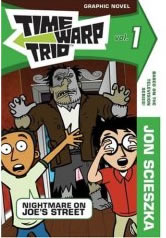
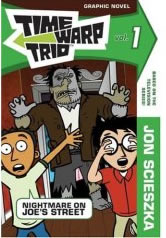
Nightmare on Joe’s Street is a graphic novel adaptation of the popular Time Warp Trio cartoon series. The story begins with a series character introduction along with a description and synopsis of the time warp device, a book, and a listing of “special guest stars” for the episode. In this episode, the monster appears in Joe’s house looking for his creator. Sam and Joe decide to warp back to the nineteenth century and return Frankenstein to Mary Shelley. Along the way the boys meet Mary Shelley, Percy Bysshe Shelley, and Lord Byron as they use music to sooth the savage monster, prevent history from changing, and locate their lost book to return home successfully. Color illustrations appear to be screen shots of the television series and perform well in graphic novel format. Fans of Scieszka’s Time Warp book series may prefer the originals; this offering may appeal to a new group of readers as well as fans of the television show.

Since it is more challenging finding graphic novel titles specifically for a juvenile collection, I was very interested in Nightmare because of it's correlation with/to the original Time Warp Trio series by Sceiezka. I enjoyed the book, the illustrations were in color, and I could envision it being used as a starter lesson for lessons on historical authors. Several reviews mentioned the illustrations were indeed screen shots from the television series, but I was unable to verify that fact online or on the series website. I imagine if the first several volumes are popular, we can look forward to more of the same.

Tags: , , , , , , ,

Tuesday, November 07, 2006

Recent purchases, graphic novels

Since I talked about graphic novels in the previous post, I was compelled to check the new book shelf this morning and see what the most recent additions to the juvenile collection, graphic novels, were.

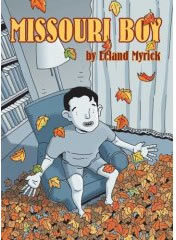
The three pictured here were added in the last two book orders. I've just returned from the circulation desk after checking them out to "me" and adding them to my shelf of books to read. It was interesting to see two of the three, Sardine and Missouri Boy, are published by the same entity, First Second (:01). The Time Warp Trio book is a HarperTrophy publication. Even more intriguing is they are all three in color and bound with heavy stock as opposed to a cheaper paperback.

Here are the three titles:

Update: later that same afternoon ...
The graphic novel bulletin board is finished. It was interesting to see how many of the novels I had chosen to highlight were checked out.

Tags: , ,

Monday, November 06, 2006

Graphic Novels

Relax, I mean graphic in design and not graphic in content. As I type that sentence I am reminded of the looks I received from student workers when they heard me asking children's literature professors if they wanted me to buy graphic novels. Once I explained it as an expanding genre in children and young adult literature, they were humorously relieved. One of the speakers at the conference on Friday discussed graphic novel collection. I enjoyed the session for several reasons, not just because I won a couple of novels in a raffle. The presenter discussed publishers of graphic novels, the graphic novel reader base in his library, how to publicize the collection, and some history behind the current trend towards graphic novel collections in public libraries. This is where the difference between public library collections and academic library collections became obvious.

Generally speaking, a public library will have their juvenile collection separated into different categories; picture books (fiction), middle readers (fiction), young adult (fiction), maybe biographies, graphic novels (fiction and non-fiction), and juvenile non-fiction. This allows for a very "browseable" collection, something the public desires. Public libraries are also responsible for purchasing titles that the general public wants to read, hence the increase in the graphic novel collections. After all, the collection is in reality their tax dollars at work.

Academic libraries are different; there are different sets of “limitations,” or collection development policies, placed on the collection. Then there is the space. Shelving a graphic novel collection within the juvenile literature is challenging as the collection encompasses fiction, non-fiction, juvenile, and young adult literature whose sole purpose is to support the college of education curriculum. Furthermore, as a research library we use library of congress and the literature is shelved accordingly. A book purchased for the juvenile collection is either juvenile or it part of the regular collection. A juvenile/young adult purchase may be placed in the recreational area, but this rare. There is no graphic novel section in the library.

So what does this mean? If graphic novels are not currently being taught in a literature class, my collection, if indeed I even have one, is minimal at best. The question of do we need graphic novels must be addressed. After conferring with children's literature professors about graphic novel purchases, I found out that one of them is requiring his students read a graphic novel. Since his class had been ordering graphic novels from other libraries, a need was not being met, and this lead to the creation of a small graphic novel collection including both juvenile and young adult selections.

Currently, the library collection includes 63 graphic novels with roughly half of them (31) considered juvenile. There are classics by Jeff Smith (Bone) and Neil Gaiman, but the juvenile titles are more difficult and include graphic interpretations of classics such as the Wizard of Oz, Call of the Wild, Tarzan, Mary Shelly's Frankenstein, Romeo and Juliet, and Macbeth. To support this collection graphic novel bibliographies and history and criticism resources have been added to the resource center reference collection. While there are some who question the inclusion of graphic novels in an academic library, this genre deserves to be represented for the literature and art styles presented within.

Tags: , ,